


You are not someone who just needs to try harder.
If you’ve ever found yourself staring at a simple task, email, errand, decision, and felt your body lock up while your brain quietly spirals…
You’re not alone.
For adults with ADHD, these moments aren’t about motivation or effort. They’re the collision of executive function overload, time blindness, emotional weight, and a nervous system that’s already running at capacity. The tasks pile up. The shame creeps in.
And somehow it looks like everyone else is moving forward while you’re stuck trying to breathe.
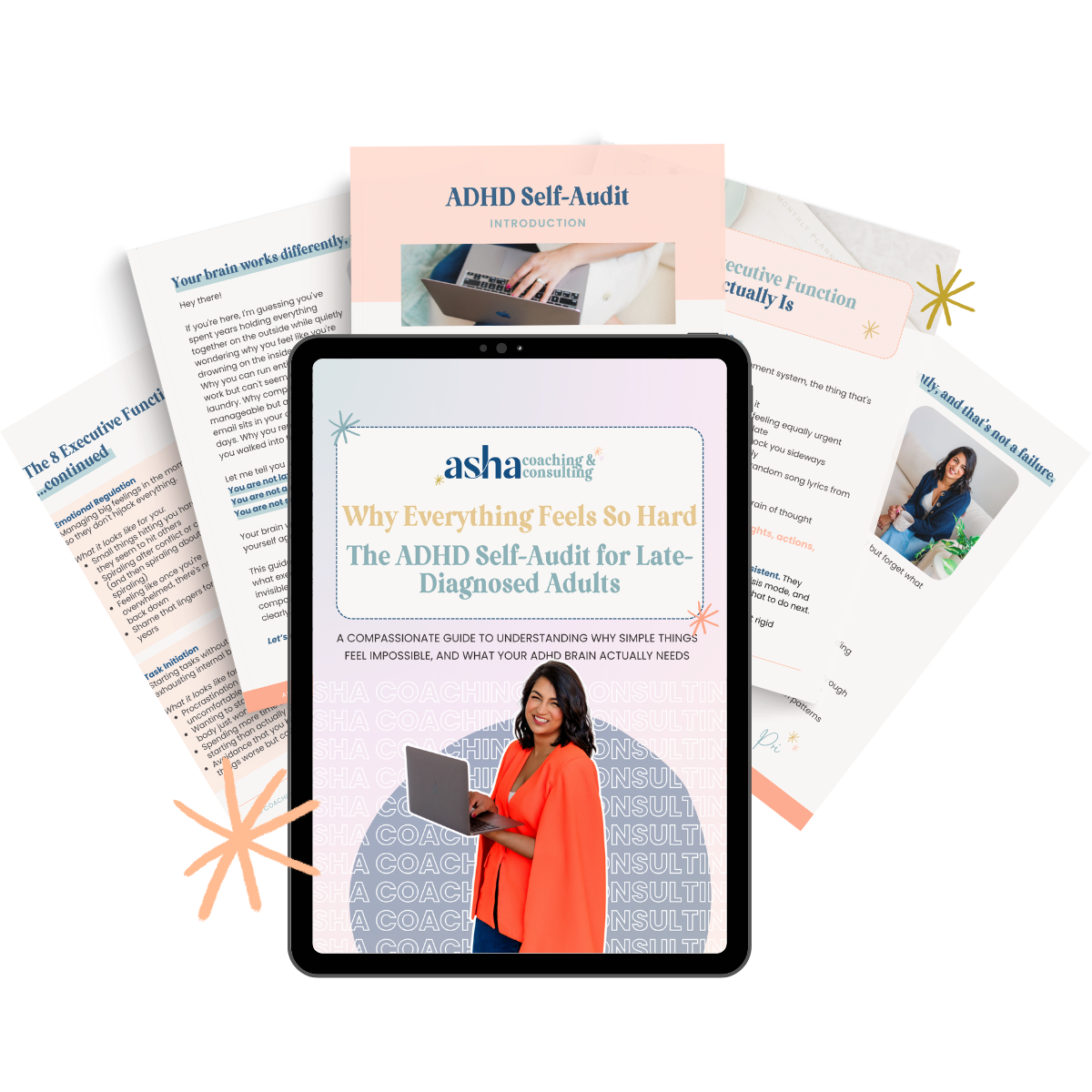
This guide isn’t about fixing you or teaching you to “try harder.”
It’s about understanding what’s actually happening.
You'll get language that names the invisible struggles and a structure that takes the chaos out of your head and places it somewhere you can see and work with, so you can stop blaming yourself and finally exhale.
(By entering your email, you'll also be added to my list, where I send helpful tips and ADHD-friendly strategies, special offers, and more. You can unsubscribe anytime.)
Here's what's included:

A SUPPORT GUIDE FOR LATE-DIAGNOSED ADHD ADULTS
Thoughtful tools and resources designed to support executive function challenges, not willpower, created by someone who understands overwhelm, inconsistency, emotional load, and the quiet exhaustion of holding it all together.

A COMPASSIONATE SELF-ASSESSMENT TOOL
A guided audit to help you identify your specific executive function patterns, see what's really going on beneath the surface, and finally understand why "simple" things feel impossible...no shame, no judgment, just clarity.

Hi, I’m Pri
Licensed Psychologist, Executive Coach, and Late-Diagnosed ADHDer
I know firsthand how frustrating it is to feel like you have so much potential but struggle to bring your ideas to life. For years, I blamed myself for my procrastination, forgetfulness, and tendency to hyperfocus on everything except the thing I actually needed to do. Then I learned I had ADHD—and suddenly, my entire life made sense.
As a Licensed Psychologist and Executive Coach, I’ve spent years helping high-achieving professionals, entrepreneurs, and leaders build careers and businesses that align with their strengths instead of constantly working against them. My approach is neurodiversity-affirming, strengths-based, and built for real life, because ADHD coaching shouldn’t be about forcing you into systems that don’t work. It should be about designing strategies that fit you.